
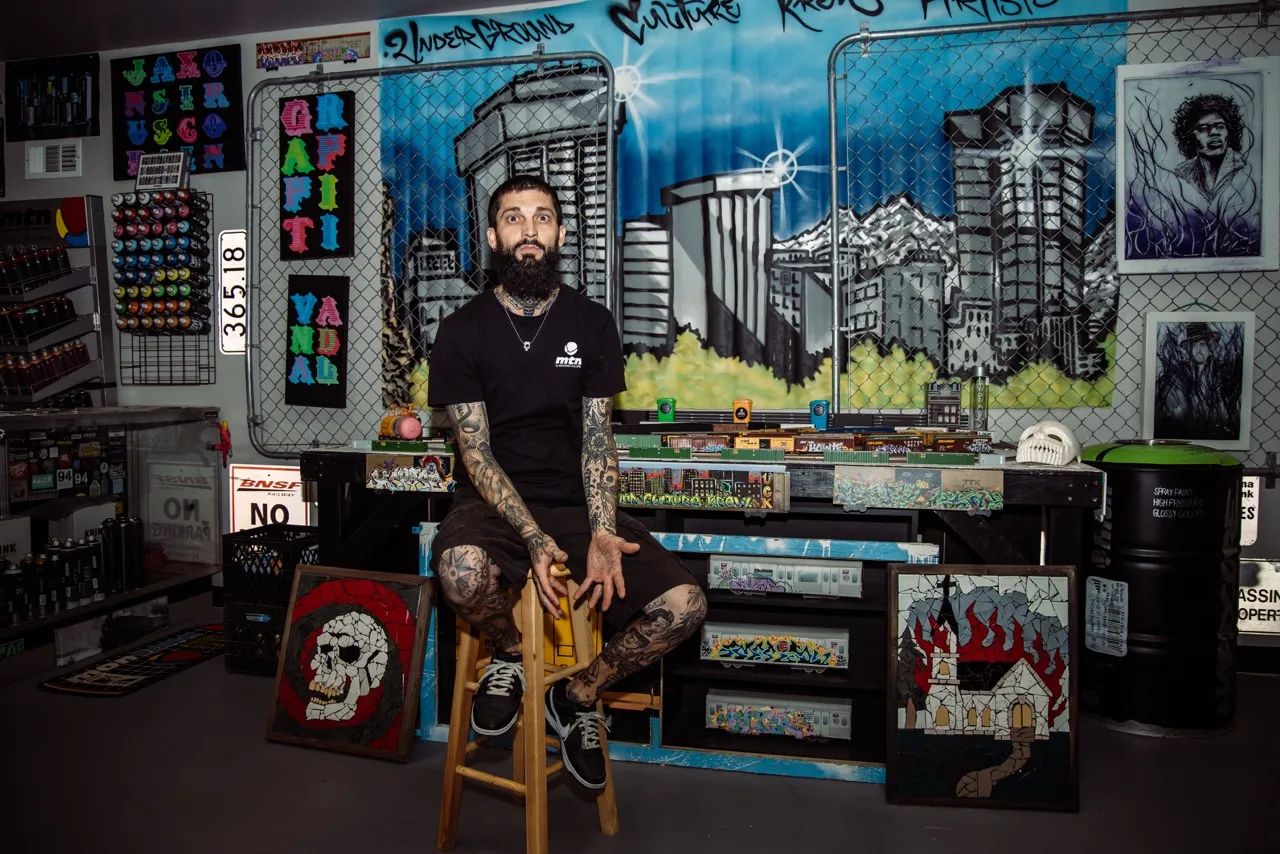
More Than a Mural
October 2026
Article by Hannah Olson
Photos by Arianna Skoog
Most of us don't remember the walls we pass every day. They blend into the background somewhere between the morning commute and the grocery store, becoming part of the scenery we no longer notice. Concrete retaining walls, blank warehouse facades, utility buildings, tunnels, and brick alleys. We drive past them hundreds of times without ever wondering what they could become. Tyson Middle notices all of them.
Where someone else sees another gray surface, he imagines color. Where others see aging infrastructure, he sees possibility. Even as a teenager on a skateboard, weaving through streets and parking lots, he learned to look at cities differently. Every rail, stairwell, loading dock, and blank wall held potential, not because it needed paint, but because it could become something that made people pause instead of pass by.
"You start looking at the city different," he says. That simple observation has quietly shaped not only Tyson's life, but increasingly the city around him.
Today, Billings is becoming known for its growing collection of murals. Children race through the vibrant tunnel on Shiloh Road. Visitors wander Art Alley with cameras in hand. Businesses commission artists instead of simply repainting blank walls. Neighborhoods celebrate public art, and Wild West Walls has brought nationally recognized muralists to a city that, not all that long ago, wasn't quite sure what to make of spray paint.
It would be easy to look at that evolution and assume Tyson Middle set out to become Billings' mural guy, but he didn't. This isn't really a story about graffiti. It's a story about what happens when someone spends years seeing possibility where everyone else sees problems.
Long before Underground Culture Krew became a fixture in Billings' creative community, Tyson was simply a kid who couldn't stop making things. Growing up between Billings and Greybull, Wyoming, he was surrounded by creativity. His grandfather, inventor LeRoy Payne, always had another project underway, encouraging curiosity as much as craftsmanship. Tyson drew constantly, experimented with clay and ceramics, designed skateboard graphics, and found himself fascinated by anything that involved building, inventing, or creating. Art wasn't a separate activity. It was simply part of who he was.
Then adulthood arrived. He worked nights to pay his way through Montana State University Billings, where he earned a degree in psychology. Jobs, responsibilities, relationships, and the practical realities of life slowly crowded out the creative work that had once defined him. The change happened gradually enough that he barely noticed until one day he realized he no longer recognized himself.
"I woke up one day and I was just like, 'I'm not me,'" he recalls. "For my whole life I did art... and then it just went poof... gone." The thought that followed was even more honest. "God, I'm miserable. I've got to figure this out," Tyson recalls.
Many people have moments like that. Few decide to rebuild their lives around the answer. Tyson walked into his mother's office with an idea that sounded almost ridiculous. What if they opened a spray-paint store in Billings? Not simply a place that sold paint, but a place where artists could gather, share ideas, exhibit work, and slowly build a creative culture that barely existed in the city at the time.
"We had no idea what the heck we were doing," he laughs. "We had big hopes and dreams."
His mother, Jackie Cheatham, didn't spend much time questioning the plan; she simply said yes. Everyone else was a little more skeptical.Prospective landlords struggled to understand why anyone would intentionally lease space to a graffiti business. Tyson remembers one asking whether renting to them meant inviting people to "get drunk, do drugs, and spray paint" the building. Others couldn't separate graffiti from vandalism. To many people, spray paint represented property damage, gangs, and trouble. The idea that it might also represent craftsmanship, community, or public art simply wasn't part of Billings' vocabulary yet.
He tells those stories now with laughter instead of bitterness. Time has given him perspective. He understands why people reacted the way they did because, for decades, graffiti had almost exclusively entered public conversation after someone else's property had been damaged. Very few people had ever watched an artist transform a blank wall with permission, much less imagined that the same medium could become a source of neighborhood pride.
Changing Minds Before Walls
Rather than arguing with people, Tyson decided to show them. It's hard not to notice how often his psychology degree emerges throughout his story, even though he rarely talks about it directly. When he says, "I have a psych degree behind all this," it explains everything that follows. Tyson isn't just interested in walls. He's interested in people.
He notices the teenager standing quietly in the corner because they're convinced they aren't talented enough to participate. He notices the kid who's acting out because it's easier than admitting they're struggling. He notices the people who have spent so much of their lives feeling like outsiders that they've stopped believing they belong anywhere creative.
Then he notices something else: potential. "I'm always trying to fix stuff," he says before quickly clarifying what he means. "I have a soft spot for kids... they all have a story. They want to be heard."
That simple philosophy quietly transformed Underground Culture Krew into something much bigger than a gallery or supply shop. One school invited Tyson to paint with students. Then another called. Before long, he found himself introducing young people across Billings to an art form many had only encountered through stereotypes. The lessons were never about lettering or color palettes. They were about confidence, giving someone permission to make mistakes, paint over them, and keep going. Spray paint, Tyson likes to point out, is forgiving. If a line doesn't work, you cover it and try again. There may not be a better metaphor for growing up.
One story captures that philosophy better than anything else. Years before Billings embraced murals, Kee Dunning offered Tyson something almost unheard of at the time. She let Underground Culture Krew paint an Angry Monkey mural on the side of her downtown building. It seems like a simple gesture today, but back then it was an act of trust. Neighbors questioned it. Police stopped by after receiving complaints. Even members of a nearby church wondered what was happening. Through every conversation, Kee calmly defended the project, reminding people that the mural had been invited, approved, and welcomed. Eventually, she joked that she ought to put Tyson's name on the deed because she spent so much time explaining why they belonged there.
Kee’s mural led to more. Shortly after, Tyson was asked to complete the Toy Story mural in downtown Billings, which was easier for many folks to accept. Looking back, Tyson doesn't remember that wall because it featured Buzz Lightyear or Woody. He remembers it because, for one of the first times, someone believed in what Underground Culture Krew was trying to become before the rest of Billings did. Sometimes, that's all a good idea needs: someone willing to see it before everyone else can.
The Mural Beyond the Wall
The Toy Story mural didn't erase decades of assumptions about graffiti, but it gave people a new reference point: neighbors working together, children watching artists create, a property owner defending a project she'd invited onto her own wall. Billings didn't change overnight. Cities rarely do. They change one conversation, one relationship, one leap of faith at a time, and Tyson kept showing up with another wall.
What stands out most isn't how often Tyson talks about murals. It's how often he talks about kids. The walls are where the lessons happen, but the real goal is helping young people discover confidence they didn't know they had. Every mistake could be painted over. Failure wasn't permanent. It was part of the process.
That same approach shaped every project that followed. Tyson laughs that his brain often works more like a logistics manager than a painter. Years at UPS taught him to think in systems, sequencing, and problem-solving, skills that proved just as valuable as artistic talent. The Billings Skate Park mural is a perfect example. When funding fell short, Tyson spent two years assembling grants, donors, partnerships, and community support until the project finally became possible.
The finished mural reached hundreds of thousands of people online, but Tyson talks far less about social media than he does about what happened afterward. Families stopped to take pictures. Kids claimed the space with pride. A place people once overlooked became somewhere worth visiting. That's the transformation that matters to him: not recognition for the artist, but a stronger connection between people and the place they call home.
That same belief in possibility eventually led to Wild West Walls, Billings' first large-scale mural festival in partnership with the Billings Industrial Revitalization District. Tyson had imagined nationally recognized artists painting alongside local talent for years, but the festival only became reality because business owners, volunteers, sponsors, nonprofits, artists, and community leaders all chose to believe in the same vision. In many ways, the festival became less a celebration of murals than a celebration of how much Billings itself had changed.
At one point, Tyson paused and said something that lingers.
"I've never fit in where I've ever been."
It's hard not to wonder if that's exactly why he notices the people and places others sometimes overlook. For nearly 14 years, Tyson Middle has encouraged Billings to look beyond gray walls and see possibility instead. Along the way, he has quietly challenged us to think differently about public art, young people, and the power of investing in places others might overlook. Somewhere in Billings today, another blank wall is waiting. Chances are, Tyson has already noticed it. The more interesting question is whether the rest of us have.
Originally printed in the October 2026 issue of Simply Local Magazine
Never miss an issue, check out SLM's digital editions here!


