
Parker Brown & The Making of a Music Town
February 2026 | Arts + Entertainment
article by Hannah Olson | photos by Arianna Skoog
AN ARTIST WHO RESISTS THE BOX
There are artists whose work exists neatly inside a genre, a venue, a single lane. And then there are artists like Parker Brown, musicians whose careers resist simple labels because they are shaped by place, people, and an ongoing willingness to evolve.
In many ways, Parker’s story mirrors the story of Billings itself.
LEAVING, RETURNING, & FINDING THE THREAD
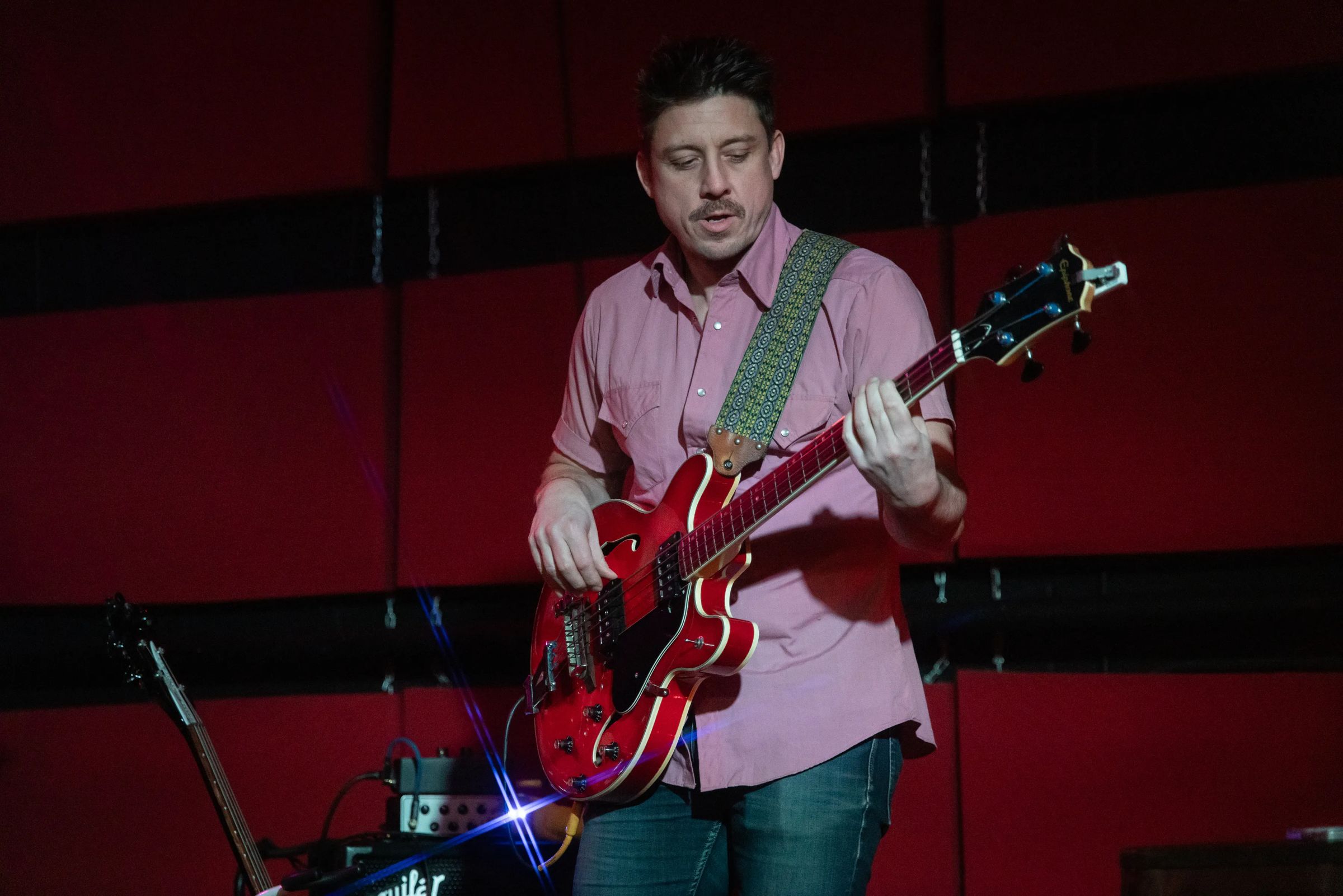
Parker was born in Billings, moved away at age 8, and returned at 20, an arc that runs counter to the familiar narrative of leaving after high school and never looking back. Music was always part of his life. His father was a musician, rehearsing in basements and touring when he could, and Parker grew up watching that world take shape. “I’ve always played music,” he says. “My dad was a musician, and I looked up to him and his friends; they were always rehearsing and doing the thing. I just thought that was awesome.”
That early exposure set something in motion. Music came naturally, but the path wasn’t always clear. For a time, Parker considered culinary school, even getting accepted into a program in New England. But when he returned to Billings, what was meant to be temporary became foundational.
That determination has quietly shaped the local music scene for more than a decade.
MAKING A LIVING IN MUSIC
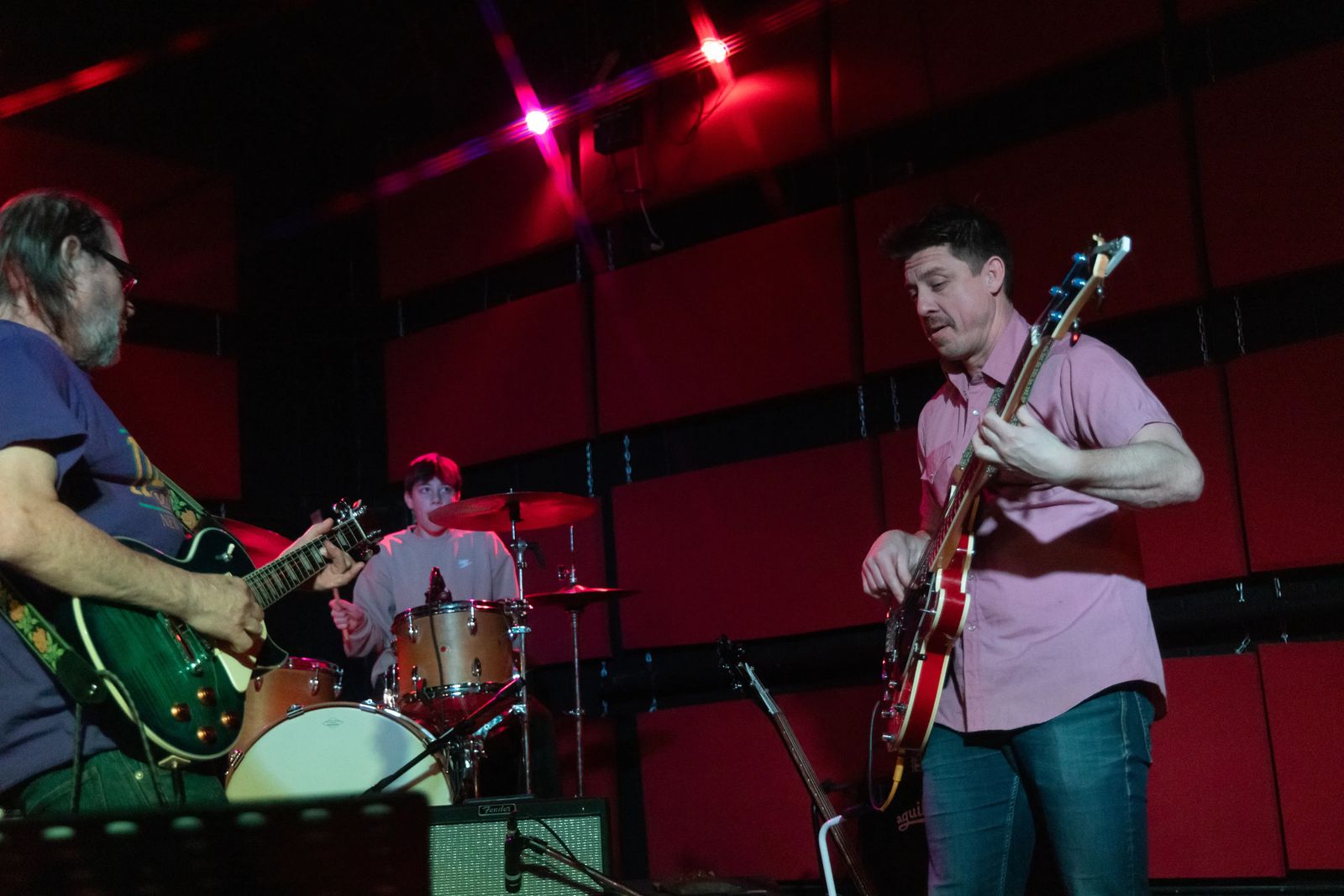
Parker has built a living as a working musician since the late 2000s, touring, freelancing, teaching, recording, and playing across genres ranging from jazz and funk to country and western. He’s a multi-instrumentalist by necessity and by instinct. “What helped is that I’m a multi-instrumentalist,” he explains. “I could diversify (upright bass, electric bass, guitar, songwriting) so I could make it work.”
That adaptability feels deeply Billings-coded.
HOW A SCENE GROWS
When Parker first returned, opportunities to hear original music were few and far between. “The only places I really saw original music happening were what Sean Lynch was doing with 1111 Presents, the metal shows at the FOE, and what Bill Honaker was doing with jazz at Walkers,” he recalls. From there, the scene expanded through intentional effort and shared commitment.
Over time, jam nights, songwriter rounds, and consistent work from musicians who showed up week after week, often for tips, helped build momentum. “We did a jazz jam for eight years,” Parker says, noting the collaborative effort alongside Alex Nauman and Brad Edwards. “Almost every Thursday. That kind of consistency builds a scene.” He’s quick to credit others who helped shape that growth, including Tim and Pam Goodridge, whose work with Blues Fest and bringing touring acts to Billings helped broaden what felt possible.
Billings didn’t arrive at its current moment through polish or trendiness. It grew through effort. Through people choosing to stay. Through artists investing in each other rather than chasing the next city over.
STEWARDSHIP OVER SPOTLIGHT
That’s where Parker’s role shifts from individual success to stewardship.
He teaches private lessons, operates a recording studio, and actively performs in the community, believing that visibility matters. “Teaching is huge,” he says, “but it’s also important that teachers are out in the community playing.” Students don’t just learn technique; they learn what it looks like to build a life in music without leaving home.
A CITY THAT LETS YOU BE YOURSELF
This philosophy extends beyond music. Parker speaks about Billings with the protectiveness of someone who understands its misunderstood edges. “Our blue-collar-ness is special,” he says. “We’re not homogenized.” In a state where towns are often compared against one another, he’s quick to point out what Billings does differently. “Here, you can just be yourself. You don’t have to posture.”
That freedom to exist without fitting a prescribed mold is what makes Billings fertile ground for artists who don’t want to be boxed in. It’s also what makes Parker’s own identity as a musician harder to define. He’s part of multiple bands. He plays behind the scenes and in the spotlight. He’s careful about where he places his name. “It’s hard because I do so many things, and it confuses people,” he admits. “I’m trying to build an identity where people know that if my name is attached to something, it’s going to be a high-quality show.” That quality is what defines his craft beyond any genre or sound.
IMAGINING WHAT COMES NEXT
Quality, earned, consistent, and community-rooted, comes up again and again in Parker’s vision for Billings’ future. For him, quality of place isn’t something that happens by accident or branding alone; it’s something built intentionally, with artists included in the conversation about what a community becomes.
Asked what he would build with unlimited resources, Parker doesn’t hesitate. He imagines space: rehearsal rooms, studios, classrooms… places where artists could create without juggling multiple jobs to survive. “If I just had a building,” he says, “I could do a ton here.” His larger pipe dream is even bolder: an accredited arts school where students could study craft and business side by side, where creativity isn’t treated as an afterthought but as infrastructure.
At the same time, Parker is careful to acknowledge what already exists. Billings supports its artists, he says, but the circle is often smaller than the city itself. The fact that he’s been able to make a career in music here for nearly twenty years is something he doesn’t take lightly. It’s a testament to the people who show up, buy tickets, take lessons, and believe that the performing arts belong here."Quality of place isn’t built by banks and casinos,” Parker says. “It’s built by culture.”
“Coming back felt like a healing thing, like returning to my roots,
I developed this Billings pride and this determination to bring high-quality music here.”
-Parker Brown
STILL BECOMING
And yet, he stays.
He stays because he believes Billings is still becoming. Because he believes eclecticism is a strength. Because he believes that if you invest in people, in their ideas, their art, their willingness to build, something real takes root.
“How do we keep the cool kids here?” he asks. His answer is simple and quietly radical: cool art, cool music, cool places to gather, and the courage to take artists seriously as architects of community.
In that sense, Parker Brown isn’t just part of Billings’ music scene. He’s part of its ongoing definition.
PARKER BROWN WILL PERFORM A LISTENING ROOM SHOW AT JIMMY’S ROADHOUSE ON FRIDAY, MARCH 13, 2026.
Originally printed in the February 2026 issue of Simply Local Magazine
Check this article out in the digital issue of Simply Local here!


