
Reimagining the American West with Gordon McConnell
July 2026
Article by Hannah Olson
Photos by Arianna Skoog
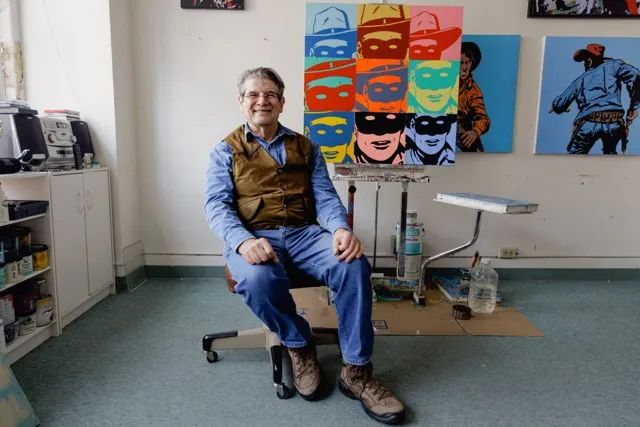
Long before Gordon McConnell ever painted the American West, he inherited it. Not the land itself, at least not yet, but the mythology of it. The version stitched together through western films, family stories, scouting trips, old illustrations, and the larger-than-life imagery that shaped generations of Americans long before they ever set foot in Montana.
Born and raised in rural Colorado, McConnell grew up surrounded by the visual language of the West. He studied art at Baylor University, attended the California Institute of the Arts, and later earned his master's degree from the University of Colorado Boulder in 1979. Even before moving to Montana, western imagery had already taken deep root in his imagination through film, painting, and the cultural mythology surrounding cowboy life.
That mythology followed him into Billings in the early 1980s, when he came to work at the Yellowstone Art Museum. What began as a professional opportunity became a defining chapter of his life and artistic evolution. McConnell would spend nearly two decades working as a curator at the museum before leaving in 1999 to pursue painting and independent curatorial work full-time.
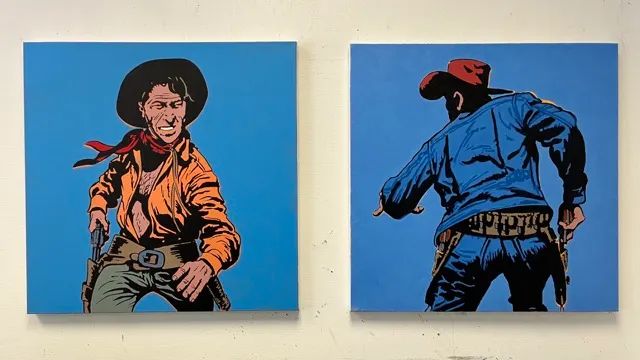
Along the way, he became one of Montana's most thoughtful and distinctive contemporary western artists, creating work that both embraces and interrogates the mythology of the American West. His paintings are rooted in Western imagery, but they resist easy nostalgia. Cowboys blur across the canvas in motion. Horses gallop through fragmented frames. Comic book references collide with old movie posters. Traditional Western iconography bends into something more psychological, more contemporary, and more emotionally layered. His work does not simply celebrate the mythology of the West. It questions it.
The Movies Came First
McConnell laughs easily when talking about Western films, but there is seriousness beneath it, too. The movies mattered to him. They still do.
"I've always loved western movies," he says.
Films like "Little Big Man" and "The Missouri Breaks" shaped his earliest understanding of Montana before he ever lived here. So did the paintings of Frederic Remington and Charles Russell, whose imagery helped define how America first came to understand the West visually. McConnell became fascinated not only by those artists, but by the chain reaction they created. Their paintings influenced Western illustrators, who in turn influenced filmmakers like John Ford and Howard Hawks, shaping generations of cultural memory. That awareness became central to his work. He began thinking deeply about how Western identity is constructed and performed, how the cowboy became both person and symbol, and how painting differs from film in its ability to hold stillness, ambiguity, and emotional tension.
Unlike cinema, painting does not move for you. It asks you to stop moving instead. "Art's a very participatory thing," McConnell says. "It's not a passive experience looking at art." He talks about how the average museum visitor spends less than 30 seconds looking at a piece of art before moving on. His work quietly pushes against that impulse. His paintings reward slowness. The longer you look, the stranger and more emotionally charged they become.
Motion, Memory, & Horses
Before the vivid color and collage elements that define much of his recent work, McConnell spent years painting almost entirely in black and white. His early paintings focused heavily on horses in motion, often inspired by frames pulled directly from western films. He describes them as "action paintings," rooted in movement and energy but filtered through a painterly, expressionistic lens.
One of his biggest influences was Eadweard Muybridge, whose groundbreaking motion studies in the 1870s captured horses galloping frame by frame. Before Muybridge, painters often inaccurately depicted how horses actually moved. His photography changed Western art forever. McConnell became fascinated by that relationship between movement and image, between photography and painting, between blur and precision. "There's something ... it gets me emotionally to see an image, a giant image of horses galloping," he says.
The emotional pull of horses runs deeper than aesthetics for him. During the interview, he speaks candidly about his father's farming and ranching during his childhood, before circumstances forced the family away from that life. He rode horses as a boy and remembers ranching not as something fully lived, but as something partially lost. "It's like a loss, something that could have been," he says quietly. Then comes the sentence that seems to unlock so much of his work: "So it's a part of me that I express in the art."
That emotional undercurrent is what separates McConnell's work from simpler Western nostalgia. His paintings are not just about horses, cowboys, or movie scenes. They are about memory, longing, masculinity, movement, identity, and the complicated inheritance of Western mythology itself.
Reinventing the Western Image
Over time, McConnell's work evolved dramatically. The monochromatic realism gave way to color. Then collage. Then comic books, typography, spaghetti-western references, and pop-art influences. His newer work feels playful in some ways, but also intellectually layered.
And not everyone loved the shift. "There's a lot of pressure to not do that," he says of artistic evolution. Dealers, collectors, and traditional Western art audiences often wanted consistency and familiarity. "More monochrome horses," as he puts it. But McConnell kept changing anyway. "It changes every year," he says of his work.
That willingness to evolve feels deeply connected to the larger Montana art scene he became part of after moving here. During his years at the Yellowstone Art Museum, he worked alongside artists who pushed western art beyond romanticized tradition and into abstraction, experimentation, and deeply personal interpretation. His own work followed that same instinct. Today, McConnell's paintings are included in collections at institutions including the Buffalo Bill Center of the West, the Missoula Art Museum, the Yellowstone Art Museum, the Federal Reserve Bank in Helena, and Billings Clinic. Yet despite the recognition, he speaks most passionately not about accolades, but about the importance of local arts communities and cultural spaces. "Billings has a kind of inferiority complex," he says.
And then he starts listing everything the city actually has: musicians, symphonies, theaters, filmmakers, writers, galleries, museums, contemporary dance, and independent cinema. His frustration is not with the arts community itself, but with how often people overlook it.
A Civic Space
McConnell speaks about the Yellowstone Art Museum with the protectiveness of someone who understands what public cultural spaces actually mean to a community. "The art museum in particular is a civic space," he says. "It's an open civic space."
To him, that matters deeply in a world increasingly shaped by commercial spaces and shortened attention spans. The museum is free, accessible, and open to everyone. He talks enthusiastically about children's art exhibitions, permanent collections, rotating contemporary work, and the possibility that a painting might shift how someone sees both themselves and the place they live.
"If you take a minute," he says, "you might discover something about what you're seeing and about yourself."
That idea feels central not only to his philosophy about museums, but to his paintings themselves. They are less interested in delivering conclusions than in creating space for reflection. There are easier ways to paint the West. More marketable ways, too. Lean harder into nostalgia. Keep the cowboys clean and heroic. Let the imagery remain uncomplicated. McConnell has spent decades doing almost the opposite. His paintings acknowledge the mythology while simultaneously pulling it apart. They understand why Western imagery is seductive while also asking what exists underneath it: memory, performance, loneliness, masculinity, violence, beauty, and reinvention.
And maybe that complexity is what makes the work feel so alive. Gordon McConnell does not paint the West as a finished story. He paints it as something still being argued with, reimagined, and emotionally unpacked in real time.
Originally printed in the July 2026 issue of Simply Local Magazine
Never miss an issue, check out SLM's digital editions here!


