
The Art of Becoming Yourself
October 2026
Article by Hannah Olson
Photos by Arianna Skoog
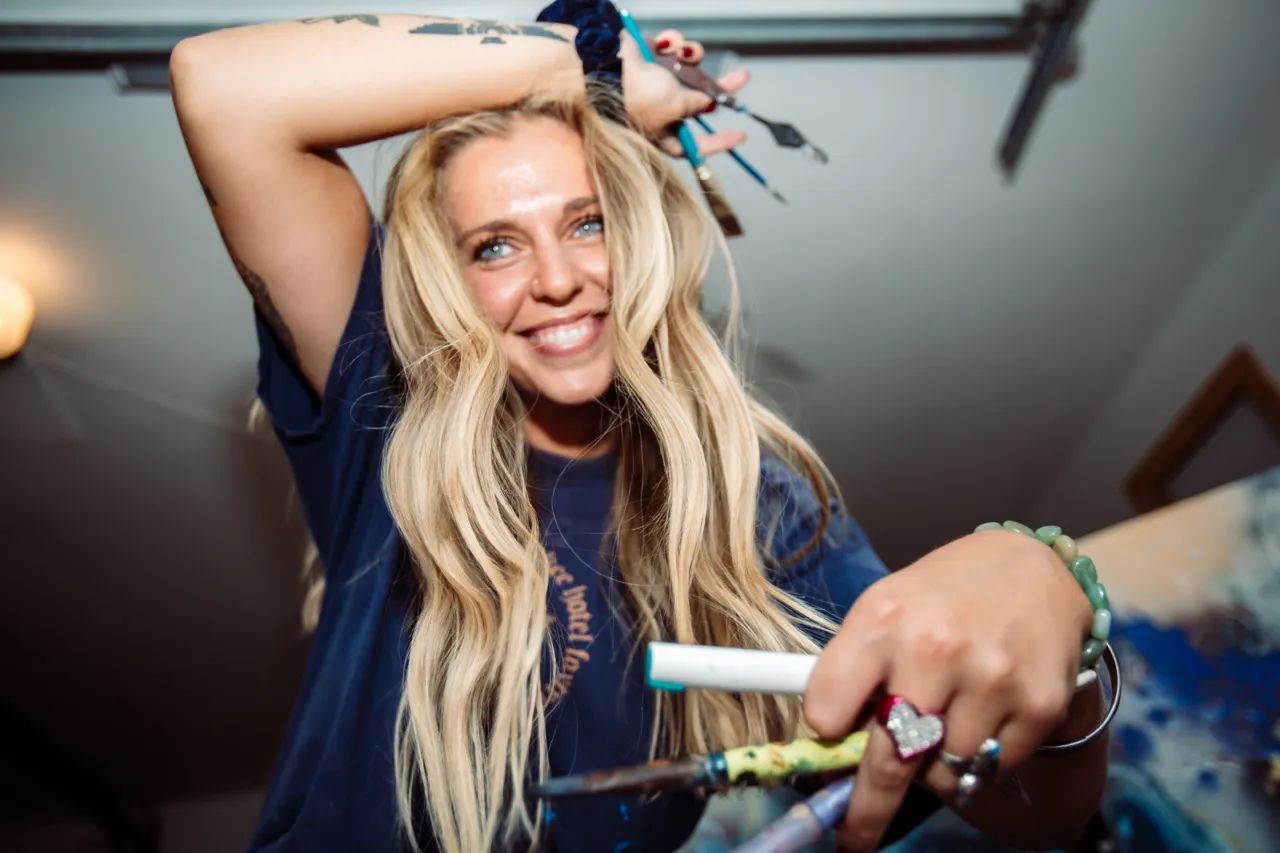
Ruby Hahn has always been a little difficult to contain. Long before her work appeared in homes, galleries, murals, and exhibitions around Montana, Ruby was the little girl who disappeared into a closet to draw. One of her earliest self-portraits showed a tiny Ruby beneath a rainbow with a message that now feels almost prophetic: "Always be yourself." She remembers being no more than five and answering the familiar question about what she wanted to be when she grew up without hesitation: "Artist."
The adults around her took that certainty seriously. Her mother framed Ruby's childhood doodles, including colorful "star explosions," and hung them in the family kitchen. At Billings West High School, art teachers Brittany Levang and the late Sue Dolan created the kind of classroom Ruby still remembers vividly: music blasting, paint everywhere, room to experiment. "I just felt so at home," she says. "It's always been my safe space." That safety would eventually give Ruby the confidence to build a life very different from the one people advised her to choose.
Too Much of a Free Spirit
As Ruby got older, encouragement came with caveats. Being an artist sounded wonderful, but it was risky. Maybe she should become an art teacher, with benefits, insurance, and a reliable paycheck. Ruby enrolled at Montana State University Billings, earned a degree in art education, and fully expected to teach.
Then she went to Italy. At the Venice Biennale, Ruby encountered contemporary artists from around the world and realized people were actually making lives out of creating, experimenting, and being fully themselves. "It totally changed my life," Ruby says. "It just rewired my brain." She came home thinking, "I have to do everything in my power to be an artist." She finished her degree, was offered a teaching job, and turned it down.
Ruby spent part of her twenties traveling, following bands and working around music festivals. There were periods when she pushed art aside, although it never really left her. In Bend, Oregon, she remembers staring at a mural outside a café and feeling that familiar pull again. Eventually she stopped trying to outrun it.
Getting It Weird
Ruby's artistic identity has never been particularly interested in behaving, either. Her early work explored scale and perspective, comparing microscopic patterns in nature with enormous landscapes and skies. Her senior capstone, An Affinity of Details, examined what changes when we move closer to something, step back, and look again, a concept that still influences her work.
In her parents' garage, Ruby experimented with anything that might create an interesting reaction on canvas: WD-40, nail polish, remover, and household chemicals. "Whatever I could do in my early work just to get it weird," she says. Eventually, combinations of spray paint, water, and acrylic became part of her signature style.
She has treated her life similarly: trying, failing, changing course, and trusting that worthwhile things often exist just beyond discomfort. "You have to be a little bit delusional in your dreams," she says. Her filter for criticism is equally direct: Would I want to trade lives with this person? If not, why should their opinion determine what she does with hers? "Stay delusional," she says, "and don't let anyone tell you you can't follow your dreams."
Betting on Herself
For years, Ruby bartended while building her artistic career on the side. Customers became familiar faces at exhibitions. Friends brought friends. Her father invited people he knew. Slowly, a network formed around her work. A mural at Black Canyon Bistro in Red Lodge helped push her over the edge. Ruby quit bartending and "dove into the unknown, just trusting my art and myself and my talents."
The romantic version ends there. The real one includes Ruby rationing inexpensive sandwiches into multiple meals while spending months building toward an ArtWalk exhibition with little income coming in. "I also kind of wanted to feel the lowness of it," she says. Then people showed up. She sold several originals. Commissions followed, and the community she had spent years building relationships with began supporting her in tangible ways. "I give so much of my credit to this town," she says. That gratitude is especially striking because Ruby once desperately wanted to leave it.
Leaving Montana to See It Again
As a teenager and young adult, Ruby thought Billings was boring, and Montana was somewhere she needed to escape. Travel complicated that idea. During one period in the South, she became so homesick she remembers thinking, "I would do anything to go back to Billings."
Coming home allowed her to see the city differently. Billings had changed, particularly downtown and its arts community, but Ruby had changed too. She began recognizing value in family nearby, familiar faces, the Rims, and a creative community that becomes surprisingly expansive once you find it.
"You can say whatever you want about Billings," Ruby says, "but the people here in this town have so much heart and so much support for young adults trying to live their passion, live their dream."
She talks about beauty the same way. "Life is what you make it and your surroundings are what you make of them," she says. "You can just find beauty in everything if you have that mindset." That worldview may explain Ruby's art better than any formal artist statement could.
Becoming More Ruby
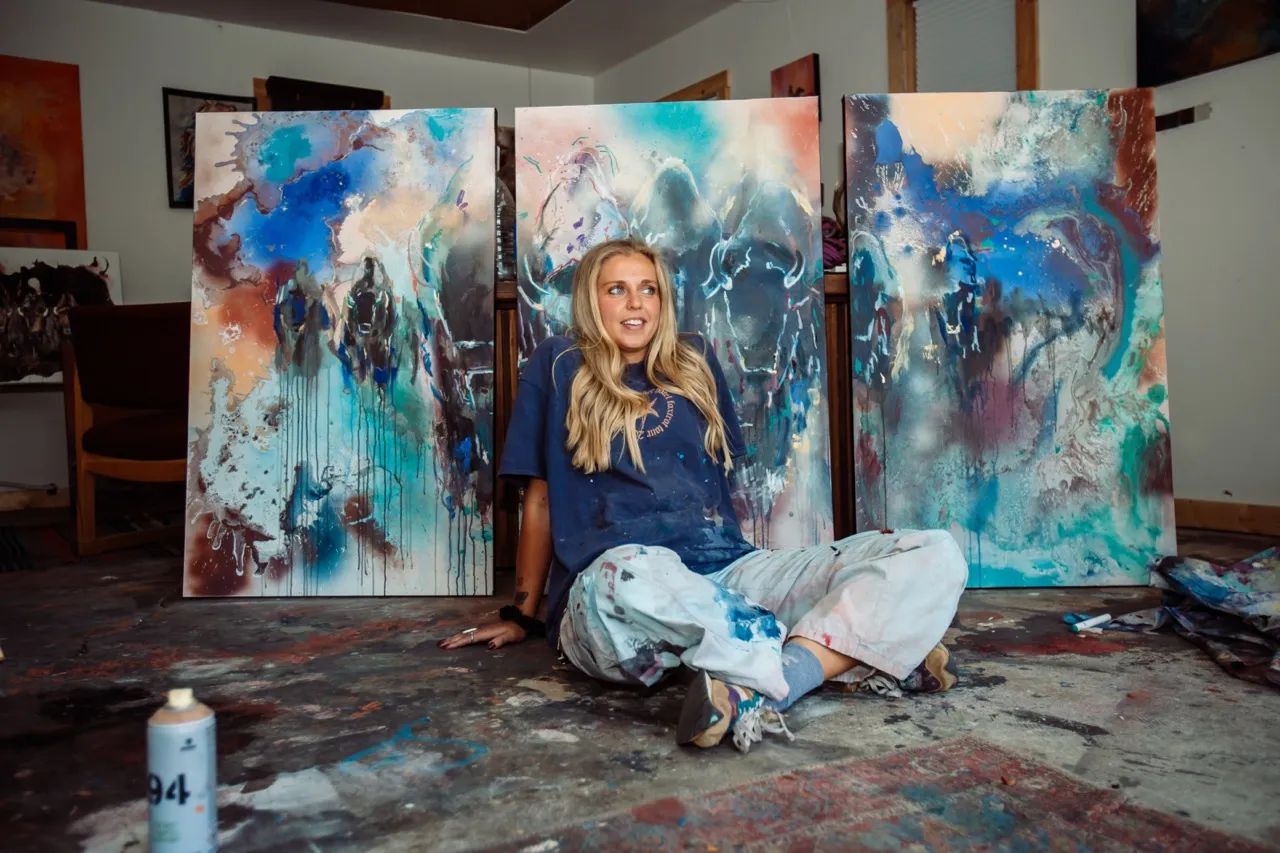
The evolution happening in Ruby's work now feels remarkably full circle. During COVID, she lost access to her studio and was stuck at home with old acrylic paint. She painted a bison after seeing an image online, posted it, and found someone wanted to buy it. More wildlife followed, and Ruby developed a genuine affection for painting the animals and landscapes surrounding her in Montana.
Eventually, though, something felt incomplete. She realized she was recreating images through her technique rather than creating from the strange, intuitive place that had always driven her abstract work. "That took away from my soul," she says. "I can't just keep doing this. I have to meld these."
That is where Ruby is now. The experimental artist who once poured chemicals onto canvases and the Montana painter who discovered wildlife almost accidentally are becoming the same person on the canvas. She begins with abstraction and lets recognizable forms emerge through it. "I feel like right now this is what I'm doing and this is my calling," she says. "It's hitting all of the things that I want to be doing."
Maybe that is why Ruby Hahn's success as an artist is impossible to separate from who she is. The curiosity that made her mix WD-40 into paint sent her across the country. The stubbornness that made her reject the safe path carried her through months without reliable income. And the sensitivity she brings to life allows her to transform what she experiences into color.
Ruby is still figuring things out, following intuition and trusting the next idea will arrive. But that little girl in the closet seems to have understood something before everyone else did. Always be yourself. Ruby Hahn has spent the rest of her life turning that childhood advice into an art form.
Originally printed in the October 2026 issue of Simply Local Magazine
Never miss an issue, check out SLM's digital editions here!


