
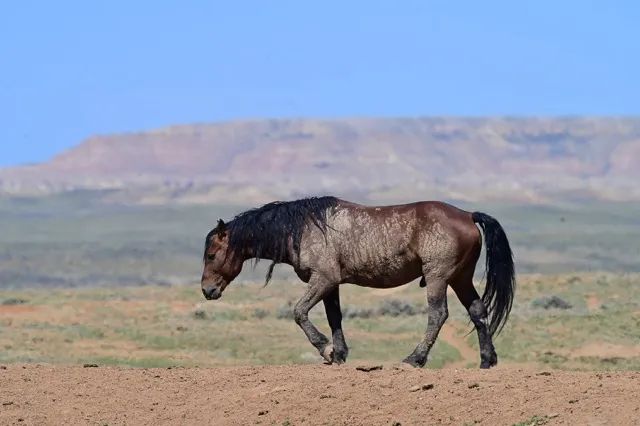
Where the West Still Runs Wild
July 2026
Article and photos by Jessica Plance
The first thing you notice in McCullough Peaks is the silence.
Not complete silence. There's wind pushing through sagebrush, gravel crunching beneath tires, and the occasional exchange between women who know this landscape better than most people know their own neighborhoods. As we make our way down the highway, Tricia Hatle scans the horizon with her binoculars from the backseat. "Over there," she says calmly, pointing toward a white speck on a distant bluff.
Binoculars pass between seats as stories overlap with laughter. Spending a day in the field with Tricia Hatle, Phyllis Preator, and Vicki Olson feels less like following guides and more like traveling with a living archive of the McCullough Peaks herd. Tricia spent more than 33 years as the Bureau of Land Management's range and wild horse specialist for the area. Phyllis has spent decades documenting and researching the herd through writing and photography, while Vicki, a FOAL (Friends of a Legacy) board member, assists with fertility control darting and herd monitoring in the field.
Among them, they can identify horses from remarkable distances, recognize bloodlines stretching back generations, and tell stories tied to nearly every ridge and reservoir winding through the badlands. Their camaraderie is effortless and decades deep.
"I couldn't have done it without Phyllis," Tricia says. "Meeting her was just another one of those magical things. "The pair met in the mid-1990s over a mountain lion, of all things, and have spent decades photographing, researching, and promoting the horses together. "We did all kinds of fun things," Tricia says with a laugh. "Pony Express rides, parades, Mustang promotions. We were definitely the PR."
The women still swap stories about riding adopted Mustangs in parades and field events. "Mustangs do it better than some domestic horses," Phyllis jokes. Out here, the horses are not distant wildlife or abstract Western symbols. They are individuals with histories, personalities, and generations of stories attached to them.
A Landscape Shaped by Balance
The McCullough Peaks Wild Horse Herd Management Area stretches across more than 120,000 acres east of Cody and south of Powell, Wyoming. From the highway, the land can look deceptively simple, open prairie rolling toward distant hills. But once inside the herd area, the landscape quickly shifts to steep ridges, dry washes, and rugged badlands covered in sagebrush and native grasses. "People see open prairie from the highway," Vicki says, "but the horses live in a surprisingly harsh and rugged landscape."
The mustangs share this sagebrush steppe ecosystem with migratory antelope, seasonal cattle, birds of prey, and countless smaller species. Water and forage can be limited, making balance essential. "The ecosystem only works when everything stays in balance," Vicki says.
That balance has shaped much of McCullough Peaks' history. "It's a competition for space, basically," Tricia says. "BLM lands are multiple-use lands." Those uses include grazing, recreation, wildlife habitat, archaeology, tourism, and energy development, all layered across the same landscape.
Generations of History
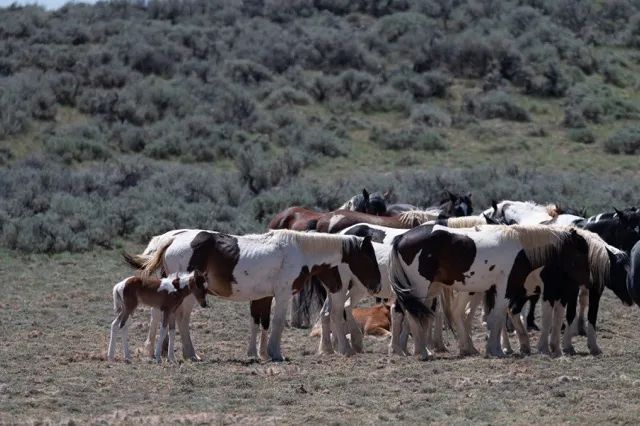
For years, Phyllis has researched the ancestry of the McCullough Peaks herd through oral histories, local records, and genetic studies. "People always ask, 'What breed are they?'" she wrote. "Mustangs are of mixed origins. Mustang is not a breed, but they are unique."
According to Phyllis' research, the herd reflects centuries of history across the West, influenced by Indigenous trade routes, ranching traditions, settlement, and the working horses that helped build communities throughout the Big Horn Basin. The landscape itself tells an even older story. Fossils of Eohippus, an early horse ancestor, have been found within McCullough Peaks, connecting today's mustangs to a lineage stretching back millions of years.
History isn't confined to the horses. As the truck winds deeper into the badlands, the women point out layers of Western history embedded in the landscape itself. One overlook faces Bridger Butte and portions of the historic Bridger Trail. "Jim Bridger rode right here," Tricia says, pointing across the ridgeline. "It's amazing to have all of this history still right here in front of us."
The horses have become part of that history and part of the identity of a region many travelers pass through on their way to Yellowstone. "There's a good 30 miles where you can still see what it looked like when people came through in wagons," Tricia says. "That's pretty special."
Protecting the Herd
In 2011, McCullough Peaks became one of the first herd areas in the region to implement annual fertility control using PZP, a contraceptive vaccine delivered remotely to mares. "The main goal," Tricia says, "is to have one living offspring per mare to continue genetics and account for normal deaths that occur each year."
The program has significantly reduced the number of horses removed during gathers. "We removed 20 horses in 2013 and only 40 horses in 2024," Tricia says. "Compared to another herd where they removed 600 head. It shows how well the program works."
Organizations like FOAL have helped support those efforts through education, stewardship, and habitat improvement projects. "We do try to educate the public on the wild horses and how they play into the ecosystem," says Heather Green, FOAL's executive director.
One of those efforts is the Living Waters Initiative, which focuses on restoring reservoirs throughout the herd management area. "So far we've rehabbed 17 of the 25 reservoirs that were part of our 10-year goal," Green says. The restored water sources help distribute grazing pressure across the landscape, benefiting horses, wildlife, and livestock alike.
Experiencing McCullough Peaks
Green encourages visitors to respect both the horses and the landscape. "They're wild animals," she says. "The distance is important to keep them healthy and safe in their natural habitat." Visitors are asked to stay at least 300 feet away from the horses and remain on established roads. "It's really easy to start new roads," Green says, "and it destroys the ecosystem every time we do it."
Seeing the herd requires patience. Some days, the horses disappear entirely into the folds of the badlands. Other days, they appear on distant ridges or gather near reservoirs before slipping quietly back into the sagebrush.
By late afternoon, golden light settles across the landscape as Tricia, Phyllis, and Vicki continue scanning distant hillsides for familiar horses. They still speak about the herd with the excitement of people discovering it for the first time, even after decades.
For visitors, a drive through McCullough Peaks may last only a few hours. For those who have spent decades studying, protecting, and advocating for the horses, the relationship has become a lifelong one rooted in stewardship, friendship, and respect for a landscape that still feels remarkably wild.
Visiting McCullough Peaks
The McCullough Peaks Herd Management Area is located east of Cody and north of Powell, Wyoming, about two hours from Billings. Stop at the interpretive kiosks at the herd area entrance and contact the local BLM office for maps and current viewing recommendations before heading out.
• Stay at least 300 feet from all horses
• Never feed or approach the animals
• Stay on established roads only
• Bring water, sunscreen, snacks, and a full tank of gas
• High-clearance vehicles are recommended in some areas
• Morning and evening offer the best light for viewing
• Be patient. The horses move on their own schedule.
Originally printed in the July 2026 issue of Simply Local Magazine
Never miss an issue, check out SLM's digital editions here!


