
.jpg?fit=outside&w=1600&h=1067)
Beyond Capacity: A closer look at the people, programs, and pressures behind Yellowstone County’s jail debate
October 2026
A note before we begin: At Simply Local, we love sharing the stories that celebrate our community and the people who make Billings feel like home. But caring about our community also means having thoughtful conversations about difficult issues.
The following story is heavier than what we typically cover, but it addresses an important decision facing our community. Our goal is not to tell you what to think or how to vote, but to provide context, ask important questions, and help us all better understand the issue and one another.
Article by Hannah Olson
Photos by Seth Kroft
On a tour of the Yellowstone County Detention Facility this fall, a man in a holding cell screamed obscenities at everyone who passed, his face pressed against the glass. Jail Captain Brandon Smart didn’t dismiss him as a problem inmate. He talked about how hard it is to see someone who needs real help locked inside a jail, and about a harder truth underneath that: sometimes people in crisis end up in the justice system because, for a while, they aren’t safe on their own, and the people around them aren’t safe either.
That tension, between compassion for someone in crisis and the need to keep everyone safe, runs through the debate over the jail’s future. Yellowstone County has tried to keep people out of jail. The jail keeps getting fuller. Yellowstone County Detention Facility (YCDF) is rated for 434 people and regularly holds more than 600, at times nearing 700. On Nov. 3, the community will decide what comes next.
The question isn’t simply whether the jail is overcrowded. It’s whether, after years of efforts to divert people, speed up the justice process, and reduce unnecessary detention, Yellowstone County still needs more space.
The County has grown around the jail
The current jail opened in 1987 with 174 beds, when Yellowstone County had about 116,000 residents. Today, nearly 173,000 people live here, and Billings serves a much larger region as a hub for healthcare, commerce, transportation, and other services.
The jail has grown along the way: 100 beds were added in 1997, a 148-bed women’s unit opened in 2018, and a 72-hour holding facility followed in 2025. Until now, the County has addressed that growth in pieces, rather than through an expansion of this scale. Previous public-safety levies have helped fund growing demands on the Sheriff and County Attorney, and the County has found other ways to pay for facility additions, including completing the 2025 holding facility without a new bond or levy. Those investments added capacity and supported public-safety operations, but they did not eliminate the larger space and operating pressures that continued to grow around them.
Before adding beds, the County has tried to reduce the need for them
The County has worked with courts and other partners to move cases faster, reduce failures to appear, and avoid unnecessary jail time. The expanded arraignment court now gets many people before a judge within 24 to 72 hours of arrest, a change intended to shorten unnecessary stays for lower-level cases. The 72-hour holding facility, added in 2025, processes certain lower-level cases without occupying longer-term beds.
Through Alternatives, Inc., eligible people can receive GPS and alcohol monitoring, treatment assessments, community supervision, and case management, including help accessing housing, employment, transportation, mental-health care, and addiction treatment. Its Innovative Probation program combines support with accountability for people who may otherwise occupy a jail bed, and the County continues expanding it.
“This is not going to solve your jail problem,” Alternatives Director of Community Programs Brandy Sanders said of diversion. “But if we can get people out who don’t need to be there, and they have the appropriate supervision, monitoring, and treatment so they don’t go back, then it helps.”
The County’s 2024–2025 needs assessment, conducted by outside planning consultants, recommended a roughly $226 million expansion. Officials ultimately pursued a smaller, $175 million proposal instead, citing reforms already underway and anticipated increases in state prison capacity.
“We don’t want to do the ‘build it and they will come,’” County Attorney Scott Twito said.
But alternatives cannot eliminate every jail bed
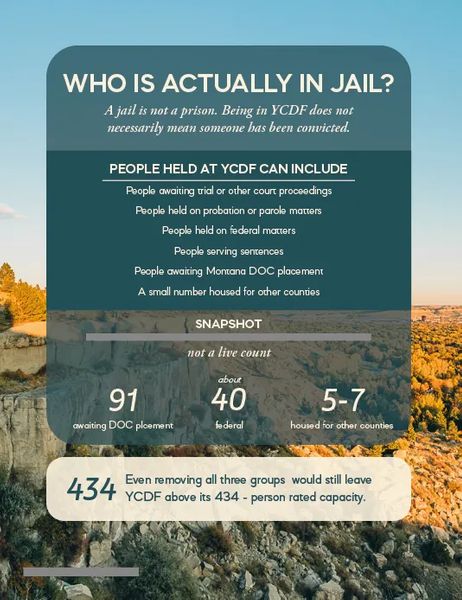
A jail is not a prison, and being held at YCDF does not necessarily mean someone has been convicted. When Undersheriff Robert Lester was interviewed, 91 people were awaiting placement in state facilities through the Montana Department of Corrections, about 40 were held on federal charges, and only five to seven were housed for other counties. Even removing all of those individuals would leave YCDF well above its 434-person capacity.
Another frequently suggested solution is the detention facility in Hardin. The County explored it, but the Bureau of Indian Affairs already uses the facility and lacks the infrastructure for its existing capacity. A county working group that studied the option in 2024 concluded that insurability, staffing, operating costs, and the need to transport detainees back to Billings for court, attorneys, and medical care made the facility impractical.
Cash bail raises another common concern. Someone may appear on the public roster with a bond of only a few hundred dollars but remain in custody because of another case, sentence, warrant, or legal hold. The roster is not a complete record and can’t be interpreted as the full picture of a person’s situation.
Research and interviews across the County’s justice system point to the same reality: community alternatives can keep many people out of jail, while secure detention remains necessary in other cases.
Overcrowding changes what happens inside, and what happens after
Capacity is about more than beds. People often need separation because of medical or mental-health needs, behavior, gang affiliations or conflicts, and other safety concerns. When a jail operates well beyond capacity, options to protect inmates and staff from intimidation or violence become limited.
Former YCDF inmate Jeremy Newell experienced that firsthand. “When you pack so many people into a big area like that with no separation, where you can’t get away from anybody, that just creates a ticking time bomb,” he said.
Overcrowding can also hinder efforts to get people out. Amanda Stonerock, who helped develop Yellowstone County’s Jail Based Program, remembers conducting assessments wherever staff could find privacy. “We are meeting in closets to do a risk assessment for somebody to talk about, ‘How do we make them healthy and help them get out of jail?’”
Rimrock’s Chyrel Snedigar describes a similar challenge. “Our position isn’t necessarily that we need more beds for more incarceration,” she said. “What we do need is better access to the people who are currently incarcerated.”
Newell’s own path included addiction, homelessness, repeated arrests, incarceration, and, eventually, recovery. He believes detention was necessary at points, but treatment, support, and a successful transition into recovery ultimately changed his trajectory. “If you’re just expanding the jail and putting more beds, then what’s the point?” Newell said. “You’ve got to add something to it. You’ve got to add a treatment aspect to it.”
The proposal includes dedicated medical and mental-health housing and program space for counseling, substance-use treatment, education, life skills, job readiness, and other services currently limited by a lack of dedicated space.
A bigger jail still cannot fix everything
Jail populations are influenced by more than crime. Poverty, housing instability, addiction, untreated mental illness, racial disparities, court and supervision practices, and access to community resources can affect who enters jail and how long they remain there.
National jail incarceration rates are lower than a decade ago. In 2024, 68% of people in local jails nationwide had not been convicted, according to the U.S. Bureau of Justice Statistics. No Yellowstone County jail expansion can solve those systemic problems, nor can one county fix Montana’s behavioral-health shortages, state prison capacity, housing instability, addiction, poverty, childhood trauma, or every other circumstance contributing to incarceration. The practical question is what Yellowstone County can control.
For some people experiencing serious mental illness, County officials acknowledge jail is not the appropriate long-term destination. “They don’t belong in jail. They belong in mental health treatment,” County Civil Attorney Melissa Williams said. Dedicated medical and mental-health housing can provide safer conditions while someone remains in custody until they can be moved to a more suitable facility.
What about the cost?
Commissioner Chris White said he entered office expecting to find substantial waste and enough savings to address major County needs without asking taxpayers for more. After working through the budget, he said his perspective changed. He found places to cut, but not enough to absorb detention and public-safety costs.
The commitment remains significant: up to $175 million in construction bonds for 332 new beds and facility renovations, plus a separate, permanent public-safety levy expected to generate approximately $20 million annually for operations.
Turning down the bond would not eliminate existing expenses. YCDF still requires staffing, medical and mental-health care, maintenance, and other operating costs, with approximately $9.5 million in deferred maintenance. The County has also faced court intervention before: a 1981 lawsuit brought by the ACLU over conditions at the previous jail led to a federal court order and, eventually, construction of the current facility, dedicated in 1987.
Anyone interested in seeing the facility firsthand can request a tour through the County’s public expansion website, which also includes the needs assessment, project documents, and frequently asked questions.
Not everyone is convinced
Opposition to the bond exists too. People who oppose it raised concerns about its cost, the size and scope of the expansion, and whether the County should exhaust its alternatives to incarceration before adding beds. Those concerns did not resolve into simple answers about what the County should do instead.
Look beyond the assumptions
The jail debate becomes less simple the more closely you examine it. People working in treatment and community corrections generally do not want more people incarcerated. Organizations like Alternatives exist specifically to provide alternatives. Jail staff must safely hold those who require detention, protect vulnerable people, provide medical and mental-health care, and manage a facility operating far beyond capacity.
Newell, who has lived inside that system, can believe all these things at once: incarceration was sometimes necessary, overcrowding made things worse, and treatment and support ultimately helped him build a different life.
“Everybody has to remember that it is a community issue,” Montana Women’s Prison Warden Katie Weston said. “It’s not just a criminal justice issue.”
That leaves the community with a consequential decision, and an opportunity to look beyond assumptions about what a jail is, who is inside it, and what additional space would actually be used for. For an issue this expensive and consequential, the questions should be hard ones. So should the questions we all ask of our own assumptions.
.png?fit=outside&w=534&h=694)
Originally printed in the October 2026 issue of Simply Local Magazine
Never miss an issue, check out SLM's digital editions here!


