
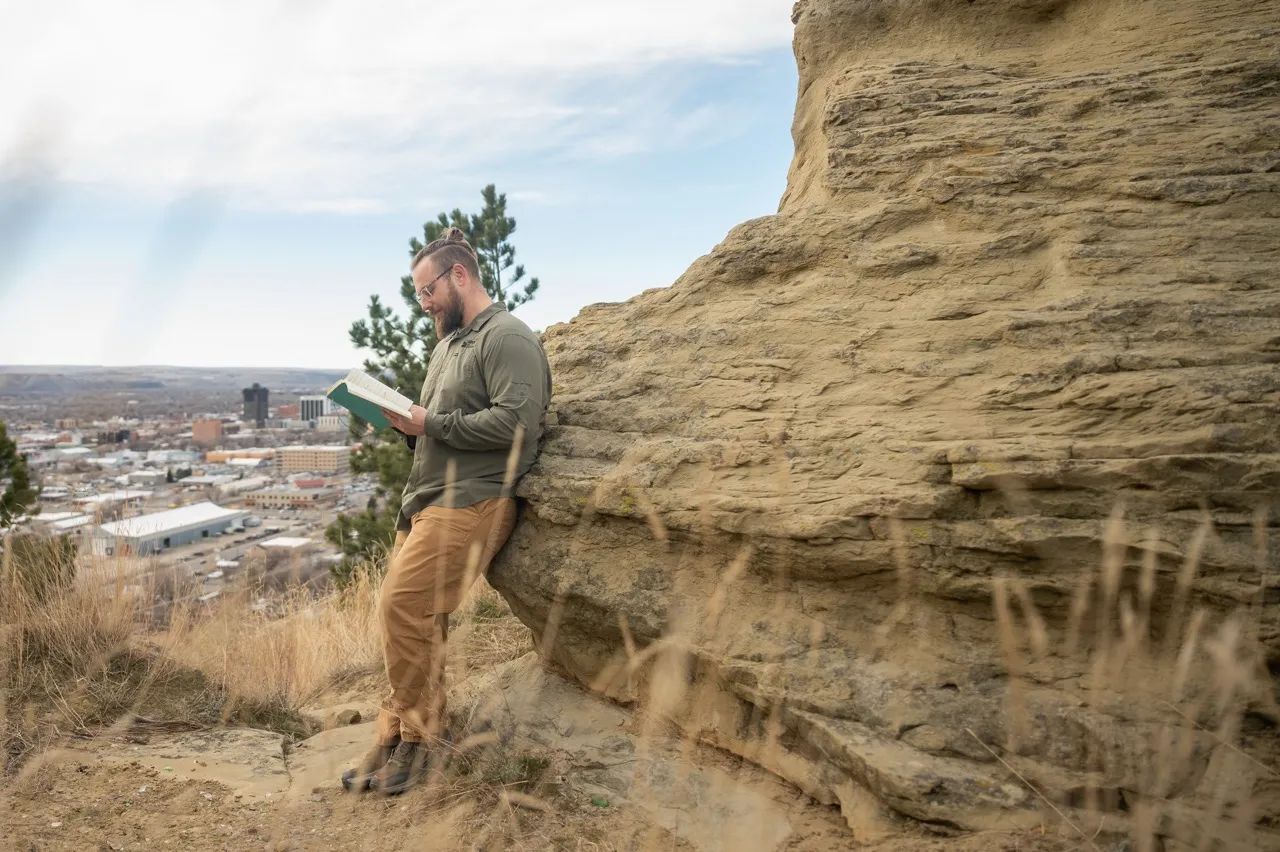
Meet Nick Miller of Billings Parks & Recreation
March 2026 | Adventure + Outdoors
article and photos by Jessica Plance
By the time you finish a walk through one of Billings’ parks, you may have noticed more than you expected: the quiet movement in tall grasses, a moth resting beneath a leaf, or the way a single tree can change how a place feels. For Nick Miller, noticing those details isn’t just a pastime; it’s his job, his passion, and now the inspiration behind a new monthly series for Simply Local.
As the forester for Billings Parks and Recreation and Public Lands (PRPL), his role is not only to maintain the health of the trees, but also to create a place of connection within the community. “I manage the 10,000 trees in the urban forest here for Billings PRPL, and over 980 acres of natural parkland,” said Nick.
Nick’s scope of work is vast. Everything living within those 980 acres is his responsibility. From trees and wildflowers to salamanders, insects, and the ecosystems that quietly support them, Nick’s work touches nearly every green corner of Billings.
“All the social and economic benefits that parks, trees, and natural areas provide, that’s what excites me,” Nick shares.
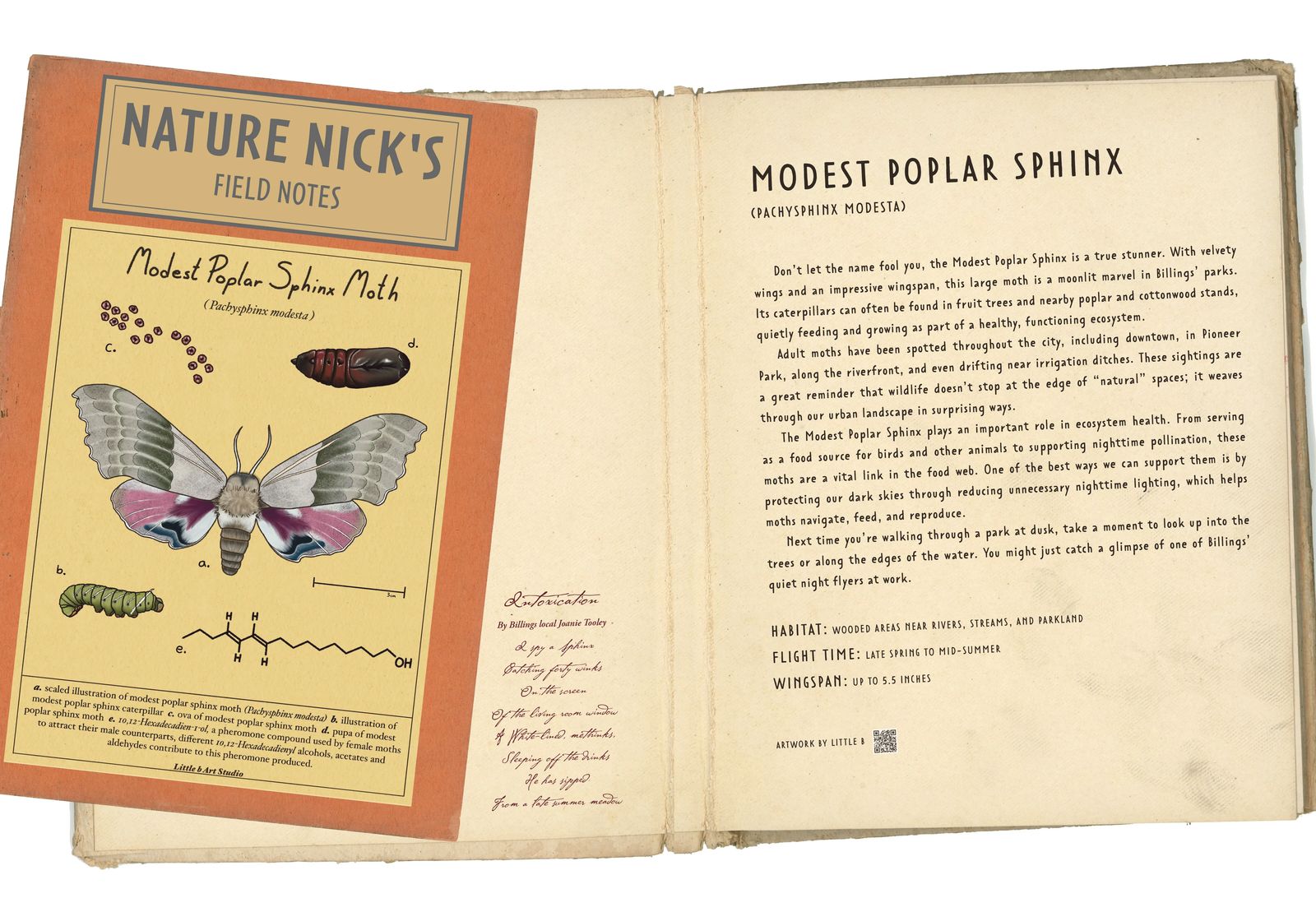
That excitement is what sparked Nature Nick’s Field Notes, a new illustrated series that will spotlight local flora, fauna, and often-overlooked invertebrates found right here in Billings. Every other month, Nick will share original artwork paired with accessible information, inviting readers to slow down and notice the natural world that exists in their neighborhoods, parks, and trails.
“You can go to the parks in Billings and find a majority of what will be featured in Field Notes,” Nick explains. “I want to bring that to people in a fun and exciting way, something we haven’t really done before.”
While mammals may seem like the obvious stars of nature storytelling, Nick intentionally turns the spotlight toward insects and invertebrates, the unsung heroes of healthy ecosystems.
“Our insects and invertebrates get overlooked,” he says. “But they’re one of the reasons we don’t cut our grasses back until late spring. Those spaces give them a place to overwinter, and that’s how we support a thriving ecosystem.”
This philosophy carries through much of Nick’s work, from pollinator beds downtown to natural areas tucked quietly throughout the city. One of his favorite places is a small, lesser-known park called Cameron.
“It’s maybe a five-minute walk,” he says, “but you get cattails, elm trees, high desert plants like yucca and sage, everything Billings has to offer in one little space. There’s even a naturally growing apple tree. If you just sit still for a moment, the whole place comes alive.” Nick’s path to forestry wasn’t linear. His inspiration came from his grandmother, who ran a seed propagation program and spent much of her life working with plants. After years of running a landscape company, he entered public service, a role that reshaped how he views community, stewardship, and even taxes.
“I didn’t understand how rewarding being a community servant could be,” he says. “Now I get to enhance the spaces I personally use, the trails I ride, the parks I visit, and see other people enjoying them too.”
“MY FAVORITE PART OF WHAT I DO IS THAT I GET TO COME TO WORK EVERY DAY AND MAKE BILLINGS A BETTER
PLACE THROUGH GREEN INFRASTRUCTURE,”
-NICK MILLER
That long-view mindset is central to his work. Nick often thinks in generations, not seasons.
“I plant trees not for myself, but for people 80, 100, 150 years from now,” he says. “I want the next person in my role to have an easier job because of the decisions we make today.”
That philosophy extends to innovative programs like the city’s composting initiative and public fruit gleaning. What started as an effort to keep plant material out of landfills has grown into a closed-loop system that now supports community gardens and local partners, and allows residents to harvest apples, plums, berries, and cherries from public parks.
At its core, Nature Nick’s Field Notes is about connection. Connection to place. Connection to systems that quietly sustain daily life. And connection to the idea that parks aren’t just for activity, but for rest.
“Passive recreation matters,” Nick says. “Reading under a tree, sitting still, letting your body relax, you can’t stop yourself from calming down when you enter a park. Your brain just knows.”
Through illustration, storytelling, and curiosity, Nick hopes Field Notes helps readers see Billings a little differently, not just as a city, but as a living, breathing ecosystem worth noticing, protecting, and celebrating. And maybe, the next time you’re in a park, you’ll pause long enough to see what’s been there all along.
Originally printed in the March 2026 issue of Simply Local Magazine
Check this article out in the digital issue of Simply Local here!


