
.jpg?fit=outside&w=1600&h=640)
Between Meetings & Manuscripts
September 2026
Article by Hannah Olson
Photos by Mary Kate Teske
Most people in Billings know Kendra Shaw through her service to the community. They've read her thoughtful explanations of city issues, watched her navigate difficult conversations with curiosity and compassion. She has earned a reputation as someone who asks good questions, listens carefully, and genuinely wants people to understand not just what is happening in our city, but why.
What many don't know is that while serving on City Council, raising two children, and helping shape the future of Billings, she was also quietly building an entirely different world. One populated by Arctic fjords, generations of one resilient family, centuries-old pianos preserved beneath icy waters, and questions about home that feel just as relevant in Montana as they do in her fictional Territory of the Arctic.
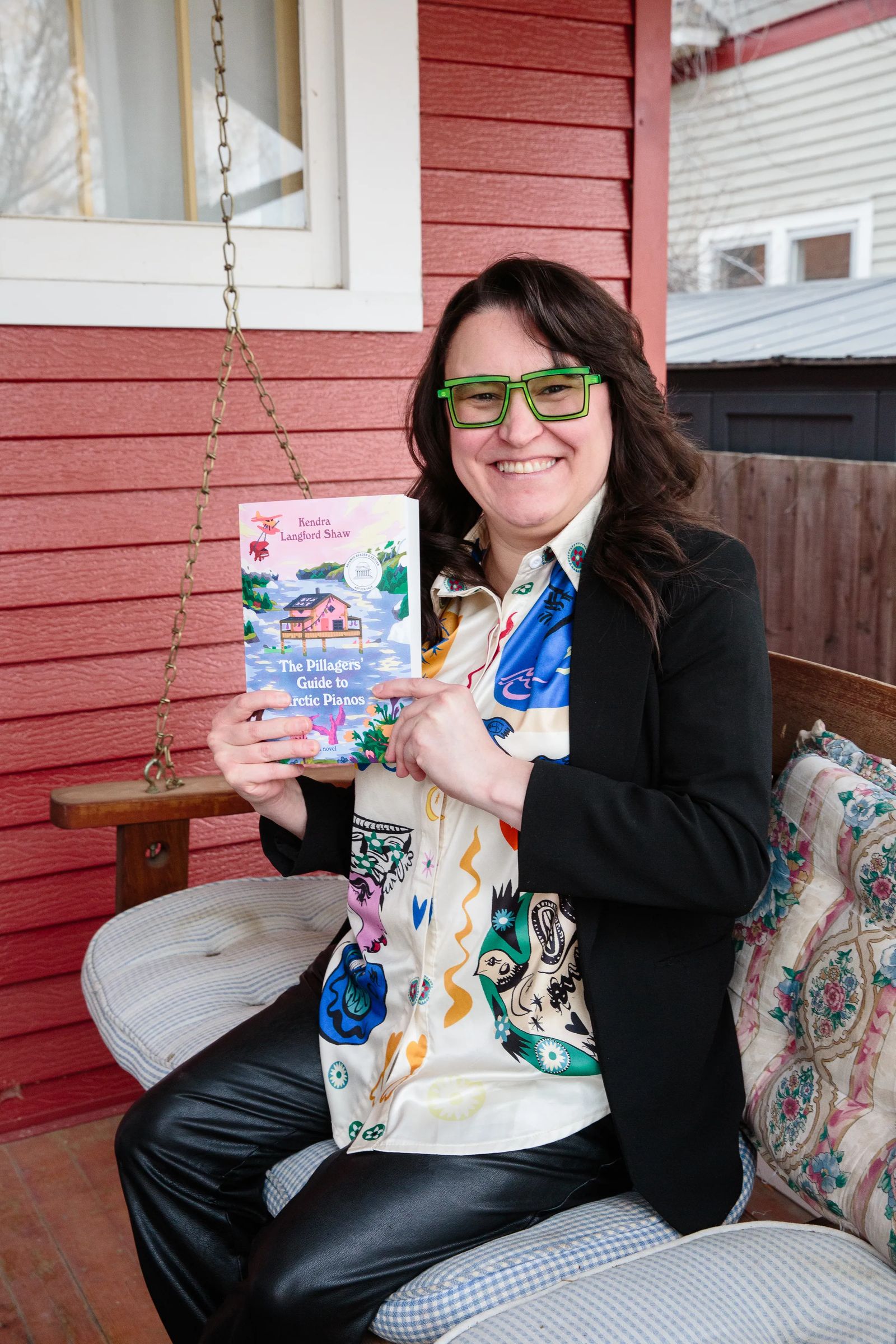
"Most people know me as a city council member," she says. The Pillagers' Guide to Arctic Pianos has now arrived. Published by Pantheon, an imprint of Penguin Random House, the debut novel has already earned a starred review from Kirkus, been named one of the summer's most anticipated books, and drawn comparisons to acclaimed authors Karen Russell and Eowyn Ivey. The Christian Science Monitor called it "a blast of fresh polar air to the fiction landscape," while Anchorage Daily News described it as "wildly imaginative" and "seductively enchanting."
It's the kind of debut many writers dream about. For Kendra, that dream began much earlier. "All I ever wanted to do was write books," she says. That simple sentence feels almost surprising coming from someone whose public identity has become so closely tied to civic leadership. But when she talks about writing, it quickly becomes clear that the two worlds aren't competing with one another. They're inseparable.
Stories Shape Everything
Ask Kendra about City Council and, before long, she's talking about storytelling. Ask her about writing fiction, and she's talking about infrastructure. To her, they're remarkably similar.
Serving on City Council changed the way she imagined fictional worlds. Instead of simply creating beautiful settings, she began asking practical questions. "It's informed both the book in terms of world building," she says. "Where did they get their water? How do you get to this place? How do you get your groceries? How is your mail delivered?" Then she laughs, realizing just how much municipal government has found its way into her imagination.
For readers of The Pillagers' Guide to Arctic Pianos, those questions become part of what makes the novel feel so immersive. The Territory of the Arctic isn't simply imagined. It functions. Its economy evolves. Families adapt. Communities change. The details feel lived-in because, in many ways, they were built with the same curiosity Kendra brings to understanding a real city. The influence goes both ways.
She believes one of government's greatest challenges isn't necessarily making difficult decisions. It's helping people understand why those decisions matter. She offers an example familiar to anyone who's ever grumbled about rising utility bills. Telling residents that water rates are increasing is one thing. Explaining that the city's water replacement schedule extends far beyond the lifespan of the infrastructure itself is another.
"That's the storytelling piece," she says. "Trying to communicate why you should care about this." It's the same instinct that drives her fiction: helping people see a world through someone else's eyes.
The Long Road to a Debut
The novel didn't appear overnight. It took more than ten years. It began as a short story during graduate school, then expanded into disconnected stories, before becoming something much larger. Along the way, Kendra repeatedly rewrote the structure, weaving generations of one family together across centuries.
"There were times when I was like, 'This is never going to go anywhere. Should I just scrap it and start something new?'" she admits. She never could. Instead, she'd tell herself one simple thing: "I'll just do one more pass." Then another. And another.
She signed with a literary agent, spent years refining the manuscript, and eventually found a home with Penguin Random House. Even then, she says, the process surprised her. Editors, copy editors, fact-checkers, designers, audiobook producers, cover artists. Every stage added another layer of polish.
"I never would have self-published," she says. "I really wanted to work with a really good editor." She speaks about that collaboration with gratitude. More than once, she recalls an editor suggesting a scene or structural change and thinking, Why didn't I think of that? For someone who believes stories are strengthened by perspective, it makes perfect sense.
Home, Wonder, and the Things That Shape Us
At its heart, The Pillagers' Guide to Arctic Pianos asks a deceptively simple question: What makes a place home? Kendra hopes readers leave thinking about that long after they finish the final page.
"Life is going to be difficult anywhere," she says. "It's easy to look like the grass is greener over there... but that's not the case." Instead, her characters keep asking another question: "How do you live the life you want in the place you want?" It's a question that feels particularly meaningful here in Billings.
Although the novel is inspired by Alaska, Montana quietly lives throughout its pages. The Yellowstone River helped shape her fictional waterways. Even raising children became part of the creative process. "My kids have definitely sucked me right back into childhood wonder," she says, describing how seeing the world through their eyes rekindled the imagination that adulthood often dulls.
She believes joy belongs beside hardship. Those aren't simply themes in her novel. They're reflections of the life she has built.
Billings Between the Pages
One of the most unexpected moments comes when Kendra begins talking about Billings' arts community. Without hesitation, she says, "We have a very talented artist community."
She points to musicians, visual artists, writers, and the growing collection of murals throughout downtown. She hopes Billings becomes known not only as Montana's largest city, but as a place where artists can afford to build meaningful lives.
"Come to Montana," she says. "You can live here, you can make a life, and have time to be an artist." She even makes an impassioned case for libraries as one of the greatest investments a community can make in creativity. "You want to be an artist?" she says with a smile. "Go to your library." It's a wonderfully Kendra answer.
Dreams Can Coincide
Perhaps the most meaningful part of the conversation wasn't about publishing at all. It was about timing. For years, Kendra carried this manuscript through a very full public life, serving her community, raising children, writing when she could, wondering if the novel would ever find its way into the world.
Now, looking back, she doesn't see those experiences as distractions. She sees them as essential. "I couldn't have written this twenty years ago," she says. "Not without thinking about the family relationships and what I've learned as a parent."
"It's never too late if you keep going. Dreams can coincide," Kendra smiles. For Billings, that's something worth celebrating. Long before readers across the country discovered The Pillagers' Guide to Arctic Pianos, it was taking shape right here, written between council meetings, family dinners, and ordinary days in a community that helped inspire its pages. It turns out the city Kendra has spent years helping build has also been helping build her all along.
The Pillagers' Guide to Arctic Pianos is available for purchase locally at This House of Books.
Originally printed in the September 2026 issue of Simply Local Magazine
Never miss an issue, check out SLM's digital editions here!


